How to Power a Camera for Hours: USB-C PD, Dummy Battery, NP-F or V-Mount
Start with the exact power methods your camera supports. USB-C, a DC coupler, NP-F or V-Mount only works well when voltage, power and compatibility all line up.
- Fixed camera
- USB-C PD or dummy
- Medium rig
- NP-F
- Larger rig
- V-Mount
- Before connecting
- Power and voltage
Contains affiliate links: if you buy through them, Daykyri earns a commission at no extra cost to you.
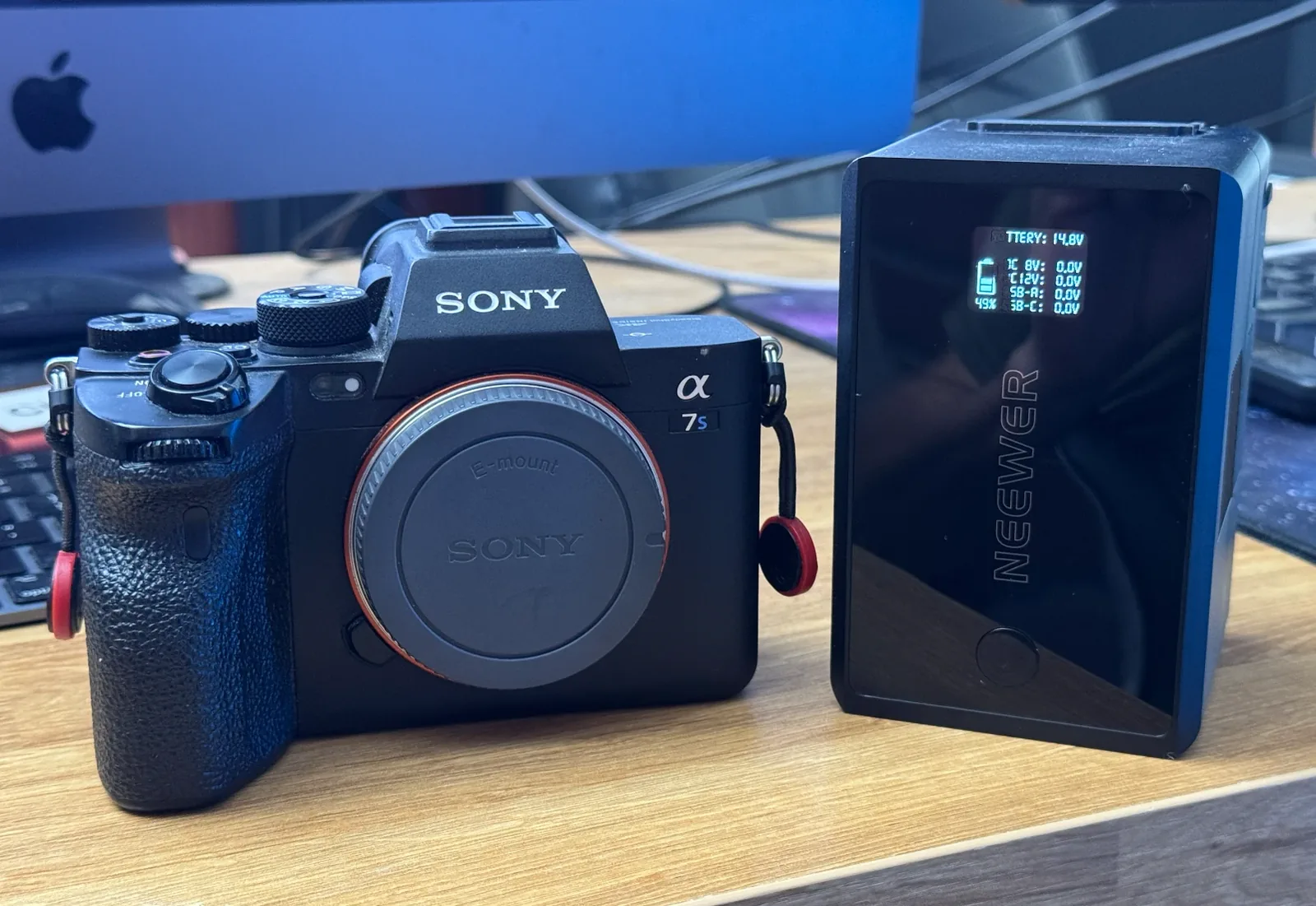
If a camera needs to stay on for hours, start with the camera specification.
Check:
What power method does this exact model support?
Then choose between:
- internal batteries;
- multiple OEM batteries;
- USB-C Power Delivery;
- dummy battery / DC coupler;
- NP-F;
- V-Mount.
There is no single power solution for every camera.
Quick answer
| Method | Best fit | Main advantage | Trade-off |
|---|---|---|---|
| Internal battery | Short shoots | Simple | Limited runtime |
| Multiple OEM batteries | Run-and-gun | Light | Battery swaps |
| USB-C PD | Compatible streaming camera | Clean setup | Needs enough power |
| Dummy/DC coupler | Fixed camera | Continuous power | Model-specific requirements |
| NP-F | Medium rig | Good balance | More mounting and cables |
| V-Mount | Long shoots / multi-device rigs | High capacity | Weight and bulk |
Start with the camera manual
Check:
- USB power support;
- Power Delivery requirements;
- required wattage;
- whether the camera can operate while powered;
- supported DC couplers;
- required voltage;
- whether an internal battery should remain installed.
A USB-C connector alone does not tell you how much power the camera can actually use.
Connected does not always mean fully powered
Sony provides a useful documented example.
Current models including cameras such as:
- A7S III;
- A7 IV;
- A7 V;
- A6700;
- FX3;
- FX30;
- FX2;
- ZV-E1;
- ZV-E10 II;
appear in its USB Power Delivery documentation.
For several NP-FZ100-based models, Sony’s table shows roughly:
Below 18 W
Power may be supplied, while battery consumption can still increase.
18–27 W
The camera can receive power, but the battery may still discharge.
27 W or more
Sony lists this as the appropriate power level for that group.
The lesson is simple:
a charging icon does not prove the source can sustain the camera.
USB-C PD for streaming
When the camera properly supports it, USB-C PD can be one of the cleanest desk solutions.
The setup becomes:
camera → USB-C PD → charger
For compatible Sony cameras, Sony recommends measures including:
- starting with a charged battery;
- enabling USB Power Supply;
- using Power Delivery when supported.
Treat that as a Sony example.
Check the documentation for your own camera brand and model.
How many watts do you need?
Whatever the camera specification requires.
Do not create a universal rule such as:
“30 W powers every mirrorless camera.”
The Sony NP-FZ100 example uses 27 W or more for the documented models.
Another camera can have different requirements.
Charger and cable both matter
The full path must support the power profile:
charger → cable → camera
A high-power charger cannot deliver its full capability through an incompatible cable or device profile.
Check the whole chain.
Search Amazon for USB-C Power Delivery chargers
Dummy battery / DC coupler
A dummy battery sits in the camera’s battery compartment and receives power from an external source.
It is useful for:
- streaming;
- studio work;
- locked-off cameras;
- long recordings.
But physical fit is only one part of compatibility.
Search Amazon for camera DC couplers
Check
- exact camera model;
- required voltage;
- regulation;
- power requirement;
- compatible supply;
- official coupler documentation where available.
Sony currently has DC coupler solutions that require power sources of 65 W or 100 W, depending on the model.
That is why “it uses USB-C” is not enough information.
USB-C PD or dummy battery?
Use the method your camera supports best.
If proper USB-C power is documented and you do not need the port for something else, it can be very clean.
If the manufacturer provides a coupler specifically designed for continuous external power, that may be the better route.
NP-F
NP-F batteries are widely used around video equipment.
With compatible regulated hardware they can power devices such as:
- monitors;
- lights;
- transmitters;
- some camera setups.
They sit between small internal batteries and a full V-Mount rig.
V-Mount
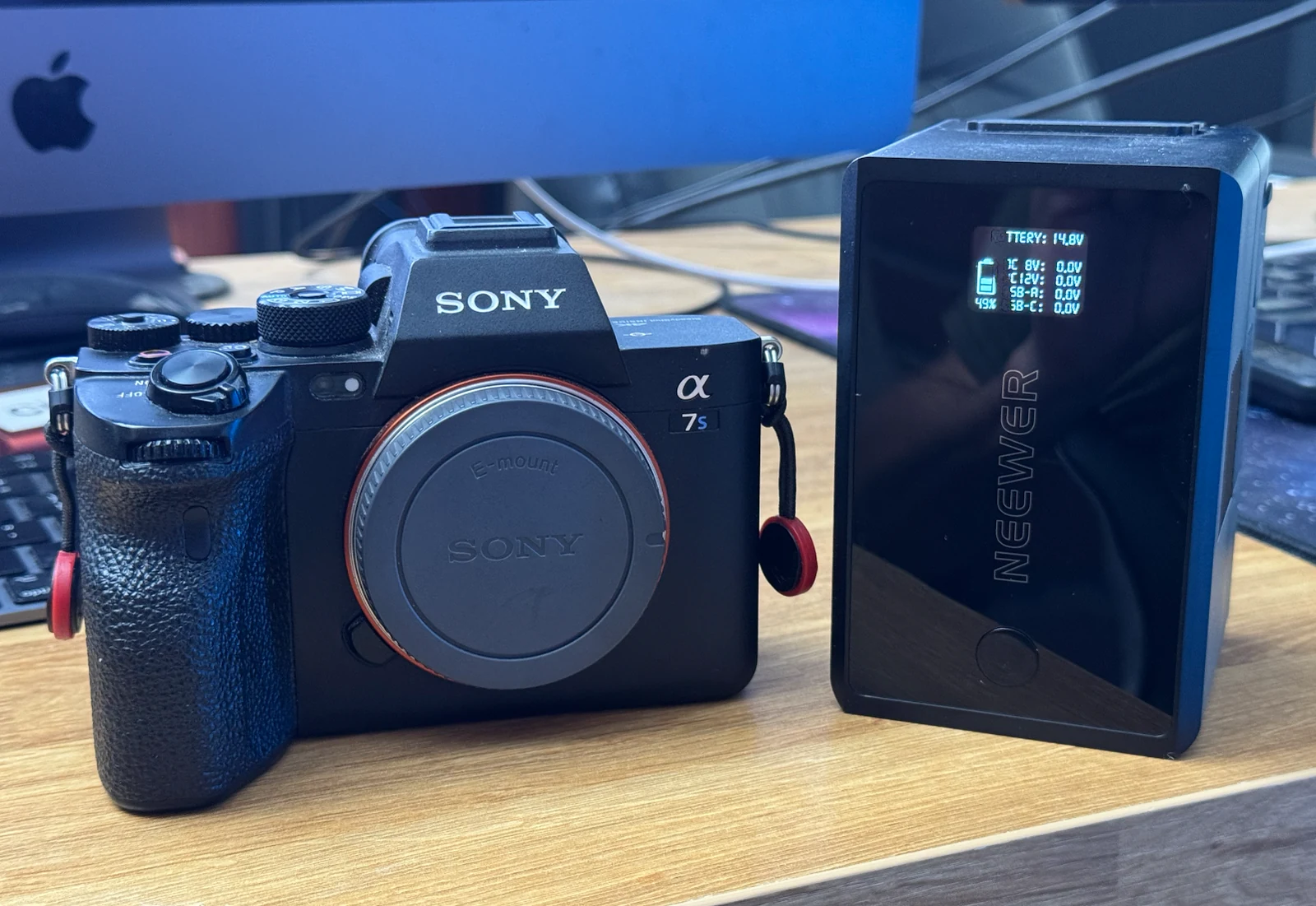
Sony α7S-series camera beside a NEEWER V-Mount battery. The pictured battery is not the SmallRig VB99 in the next example.
V-Mount becomes useful when the system grows.
For example:
- camera;
- monitor;
- transmitter;
- recorder;
- accessories.
One larger battery can power several devices when the rig is designed correctly.
Search Amazon for NEEWER V-Mount batteries
SmallRig VB99 example
The current VB99 is rated at approximately:
98.9 Wh
and provides outputs including:
- USB-C;
- USB-A;
- DC;
- BP;
- D-Tap.
SmallRig specifies bidirectional USB-C power up to:
100 W.
It also supports charging through USB-C up to 100 W.
SmallRig advertises roughly two-hour charging under appropriate conditions and more than 300 recharge cycles.
Those are manufacturer claims.
Search Amazon for SmallRig VB99
Estimating runtime
A useful rough formula is:
theoretical hours ≈ Wh ÷ watts consumed
Example:
A:
99 Wh
battery powering a:
20 W
load gives:
99 ÷ 20 = 4.95 theoretical hours
At:
40 W
the same battery gives:
99 ÷ 40 = 2.48 theoretical hours
Real runtime will differ
Because of:
- conversion losses;
- efficiency;
- temperature;
- changing camera load;
- battery condition;
- other connected devices.
Use the formula for planning.
Leave margin.
Add the whole rig
Example:
Camera:
15 W
Monitor:
10 W
Transmitter:
8 W
Total:
33 W
A 99 Wh battery gives roughly:
3 theoretical hours
before losses and changing load.
V-Mount for streaming
If the camera sits beside a wall outlet all day, a large V-Mount battery may add unnecessary weight and complexity.
USB-C PD or a documented coupler can be simpler.
V-Mount becomes more compelling when:
- wall power is unavailable;
- you need long runtime;
- several devices share one battery;
- the rig is already built around external power.
V-Mount for run-and-gun
The downside is physical.
You add:
- battery;
- plate;
- cables;
- mounting;
- weight.
For handheld work or lightweight gimbals, multiple small batteries may be more practical.
OEM batteries are still useful
Sometimes the simplest answer is:
carry three or four batteries.
For travel, documentary, street work or gimbal use, battery swaps can be easier than building an external power rig.
Is USB-C PD always safe?
Do not rely on a universal statement.
Use:
- compatible power supplies;
- correct cables;
- manufacturer specifications.
Is D-Tap dangerous?
D-Tap is an electrical output.
Safety depends on:
- voltage;
- polarity;
- regulation;
- cable;
- the device receiving power.
Never connect two devices simply because the plugs fit.
Before connecting external power
Check:
- Output voltage.
- Available power.
- Regulation.
- Camera requirement.
- Cable behavior.
- Manufacturer compatibility.
If those are unclear, stop before connecting the hardware.
What would I choose?
Desk streaming
First check documented:
USB-C PD
or:
official/compatible DC coupler.
Run-and-gun
Internal batteries.
Possibly NP-F if the rig already uses one.
Long tripod shoots
Large NP-F or V-Mount depending on total load.
Camera + monitor + transmitter
V-Mount becomes increasingly useful.
Common mistakes
Buying a charger only because it has a large wattage number
The camera still needs to accept the appropriate profile.
Buying a dummy battery because it physically fits
Voltage and regulation matter too.
Assuming USB power means zero battery drain
An underpowered source can still allow the battery to discharge.
Adding V-Mount to a tiny rig without needing it
A lightweight camera can become very bulky.
Comparing only mAh
For systems operating at different voltages, Wh is far more useful.
Frequently asked questions
Can I power a camera over USB-C for hours?
Yes, if that camera supports external USB power and the source provides enough power.
Does USB-C PD always stop battery drain?
No.
Sony documents cases where power is supplied while the internal battery still discharges if the source is not powerful enough.
How much power do Sony NP-FZ100 cameras need?
For the documented compatible group, Sony lists 27 W or more as the appropriate power level. Check your exact model.
What is a dummy battery?
A coupler that replaces the internal battery and receives power from an external source.
NP-F or V-Mount?
NP-F can keep a rig lighter. V-Mount provides more capacity and connectivity at the cost of weight and bulk.
How long does a 99 Wh battery last?
At a theoretical constant 20 W load, about 4.95 hours before accounting for losses and varying consumption.
Can one V-Mount battery power a camera and monitor?
Yes, when the outputs, cables, voltage and power requirements are all compatible.
More gear and creator guides
Standing desk for streaming and editing
Sources
Sony — USB Power Delivery compatible cameras
Sony — NP-FZ100 USB PD power requirements